Home › Legal Guides › What Happens If You Don't Pay a Traffic Challan
What Happens If You Don't Pay a Traffic Challan
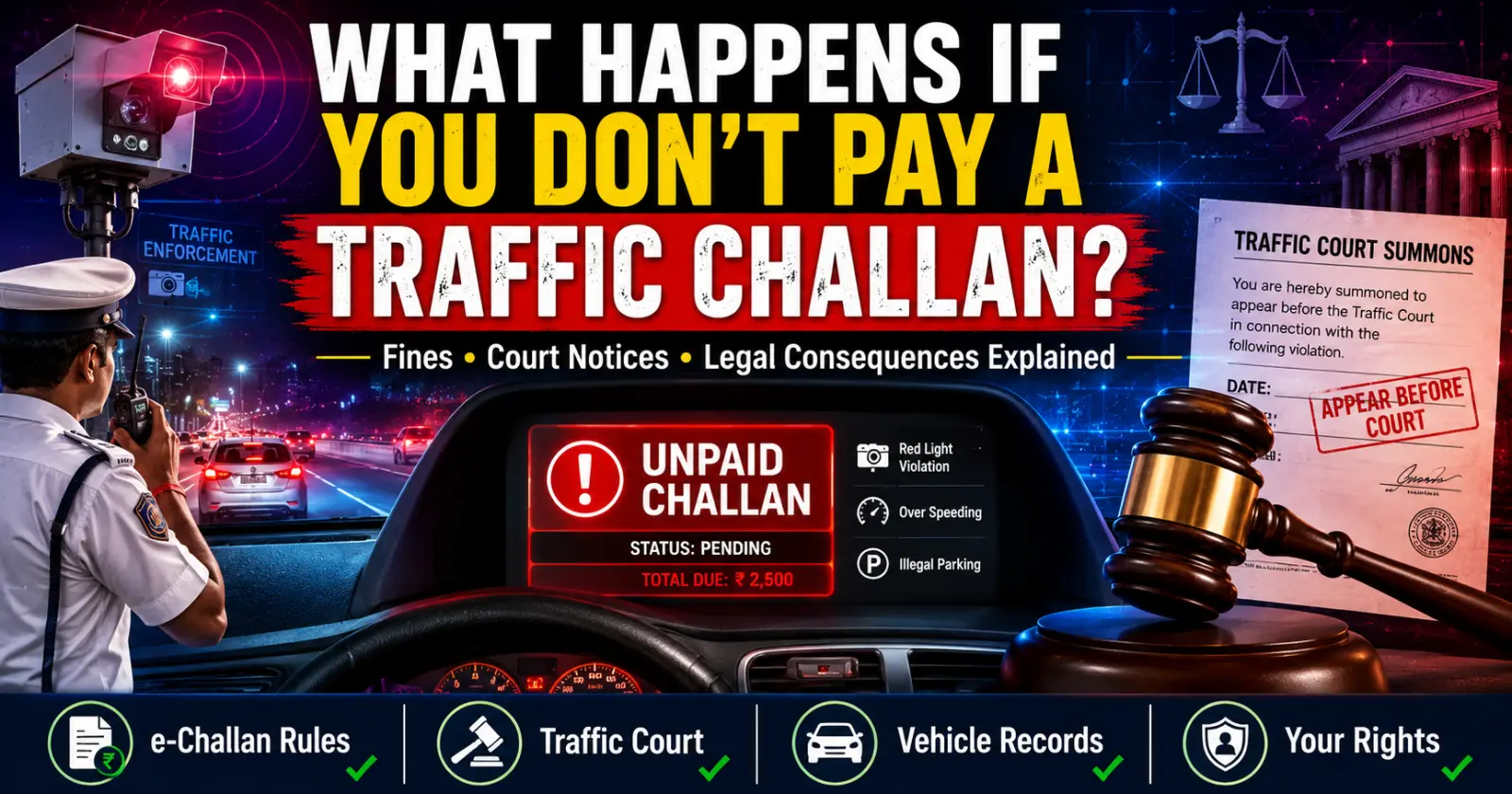
What Happens If You Don't Pay a Traffic Challan? Complete Legal Guide for Indian Drivers (2026)
Traffic challans are issued to enforce road safety and ensure compliance with traffic laws. Most motorists view a challan as a minor inconvenience, but ignoring it can lead to far more serious consequences than many people realize.
With the widespread adoption of e-Challans, automatic traffic cameras, AI-powered surveillance systems, and integrated databases, unpaid traffic fines are now much easier for authorities to track and enforce.
If you've ever wondered, "What happens if I don't pay a traffic challan?", this guide explains the legal consequences, penalties, and rights of vehicle owners in India.
Disclaimer: This article is for informational purposes only and should not be considered legal advice. Traffic laws and enforcement practices may vary by state and circumstances.
What Is a Traffic Challan?
A traffic challan is an official notice issued by traffic authorities when a motorist violates traffic laws.
Common violations include:
- Overspeeding
- Jumping a red light
- Driving without a helmet
- Not wearing a seatbelt
- Illegal parking
- Driving without valid documents
- Dangerous driving
- Using a mobile phone while driving
Today, challans are commonly issued electronically through the e-Challan system, which links violations directly to vehicle registration records.
Is Paying a Traffic Challan Mandatory?
Yes.
Once a challan is lawfully issued, the vehicle owner or driver is generally required to either:
- Pay the fine within the prescribed period, or
- Challenge the challan through the appropriate legal process.
Ignoring it altogether is usually the worst option.
Relevant Legal Provisions
Section 177 – Motor Vehicles Act, 1988
Provides for penalties for general traffic violations where no specific punishment is prescribed.
Section 183 – Motor Vehicles Act
Deals with overspeeding offenses.
Section 184 – Motor Vehicles Act
Addresses dangerous driving.
Section 129 & Section 194D
Require helmet usage and prescribe penalties for violations.
Section 194B
Deals with seatbelt violations.
Section 210B
Provides for enhanced penalties in certain situations involving repeated offenses.
What Happens If You Ignore a Traffic Challan?
1. Additional Penalties May Accumulate
The first consequence is that the unpaid challan remains outstanding in government records.
Repeated non-payment may:
- Increase scrutiny
- Lead to further legal action
- Affect future enforcement proceedings
Many states maintain digital records of pending challans.
2. You May Receive a Notice
If a challan remains unpaid, authorities may issue:
- Reminder notices
- Demand notices
- Summons in certain cases
The purpose is to inform the registered owner about the pending violation and provide an opportunity to respond.
Ignoring official notices can escalate the matter further.
3. Summons From a Traffic Court
For certain unpaid challans, especially serious violations, authorities may initiate proceedings before a traffic court.
A court summons may require you to:
- Appear before the court
- Explain the violation
- Settle the outstanding fine
Failure to respond to a valid court summons can create additional legal complications.
4. Vehicle Blacklisting in Some States
Certain state transport authorities have implemented systems that may flag vehicles with substantial unpaid challans.
Consequences may include difficulties related to:
- Vehicle transfers
- Ownership changes
- Certain transport-related services
Practices vary by state.
5. Problems During Vehicle Sale
Prospective buyers often check vehicle records before purchasing.
Pending challans may:
- Reduce buyer confidence
- Delay transactions
- Require settlement before transfer
Many buyers insist on a clean challan history before completing a purchase.
6. Issues During Vehicle Registration Services
In some situations, unpaid challans may affect processes such as:
- Ownership transfer
- NOC applications
- Registration-related services
The exact impact depends on local regulations and system integration.
7. Repeat Offender Consequences
Authorities increasingly use digital databases to identify habitual offenders.
Repeated violations combined with unpaid fines can result in:
- Increased penalties
- Greater enforcement attention
- Enhanced legal consequences
Traffic authorities generally take a stricter view of repeat offenders.
Can Police Stop You for an Unpaid Challan?
Yes.
If traffic authorities identify a vehicle with pending challans during routine checks, they may:
- Verify vehicle records
- Inform the driver about outstanding dues
- Take action as permitted by law
This does not necessarily mean immediate arrest, but unresolved violations can attract enforcement measures.
Can Your Vehicle Be Seized?
In certain circumstances, authorities may take enforcement action if there are significant legal violations or persistent non-compliance.
However, vehicle seizure generally depends on:
- Nature of the offense
- Applicable state regulations
- Court orders
- Specific enforcement powers
A single minor unpaid challan does not automatically result in vehicle seizure.
What If the Challan Was Issued Incorrectly?
Mistakes can happen.
Common examples include:
- Wrong vehicle number
- Incorrect location
- Misidentified vehicle
- Camera errors
- Duplicate challans
If you believe the challan is incorrect, you should:
Gather Evidence
Examples:
- GPS records
- Dashcam footage
- Parking receipts
- Photographs
File a Challenge
Most states provide mechanisms for:
- Online grievance submission
- Traffic department review
- Court-based challenge procedures
Do not simply ignore an incorrect challan.
How to Check Pending Traffic Challans
Vehicle owners can typically verify challans using:
Government e-Challan Portals
By entering:
- Vehicle registration number
- Chassis number
- Driving licence details
State Traffic Police Websites
Many states maintain dedicated challan portals.
Transport Department Services
Vehicle-related services often display pending violations.
How to Pay an e-Challan
Payment methods commonly include:
- UPI
- Net Banking
- Debit Cards
- Credit Cards
- Digital Wallets
Always use official government portals to avoid fraud.
Common Myths About Traffic Challans
Myth 1: "Nothing Happens If I Ignore It"
False.
Unpaid challans remain in official records and may lead to further action.
Myth 2: "Traffic Cameras Are Not Legally Valid"
False.
Automated enforcement systems are widely used and recognized for traffic management.
Myth 3: "The Challan Will Automatically Disappear"
False.
Outstanding fines generally remain until resolved through payment or legal challenge.
Myth 4: "Only the Driver Is Responsible"
Not always.
In many cases, notices are issued to the registered owner of the vehicle.
Benefits of Paying Challans Promptly
Avoid Legal Issues
Early payment prevents escalation.
Maintain Clean Records
A clean violation history may be beneficial for various vehicle-related transactions.
Save Time
Resolving matters promptly avoids court appearances and additional administrative procedures.
Promote Road Safety
Traffic enforcement ultimately aims to reduce accidents and improve public safety.
Frequently Asked Questions
1. What happens if I don't pay a traffic challan in India?
You may receive notices, face court proceedings in certain cases, encounter administrative complications, and continue to have the violation recorded against your vehicle.
2. Can I go to jail for not paying a traffic challan?
Generally, a simple unpaid challan does not directly result in imprisonment. However, ignoring court orders or legal proceedings can create more serious consequences.
3. Can police stop my vehicle for pending challans?
Yes. Traffic authorities may check outstanding challans during enforcement operations.
4. How long can a traffic challan remain unpaid?
This depends on the nature of the violation and applicable procedures. It is advisable to address challans promptly.
5. Can I challenge a wrong e-Challan?
Yes. Most traffic departments provide grievance and dispute-resolution mechanisms.
6. Can unpaid challans affect vehicle transfer?
In some cases, pending challans may create complications during ownership transfer processes.
7. How do I check pending challans online?
You can use official government e-Challan portals or state traffic police websites.
8. Can I pay a challan after receiving a notice?
Generally yes, subject to applicable procedures and timelines.
9. Are traffic camera challans valid?
Yes. Automated traffic enforcement is widely used across India.
10. What should I do after receiving a challan?
Verify the details, pay the fine if valid, or challenge it through the proper legal process if you believe it was issued incorrectly.
Written by Ashish
Career Guidance Mentor & Government Job CounsellorAshish regularly writes about government jobs, educational opportunities, competitive examinations, career planning, and student development.
Read Full Author Profile
Recent Posts

What Happens If You Don't Pay a Traffic Challan

Can Police Check Your Phone Without Permission

ChatGPT vs Gemini vs Claude: Which AI Is Best in 2026

IPC vs BNS Top 50 Important Changes Every Student Must Know (2026 Guide)

What Happens If You Don't Pay a Traffic Challan in India Complete Guide (2026)

RRB ALP 2026 Notification 11,127 Assistant Loco Pilot Vacancies Announced, Eligibility, Exam Pattern & Important Dates

SSC CGL 2026 Notification: 12,256 Vacancies Announced, Apply Online Before 22 June